How to Choose the Right IP Rating for LED Strips
What is the IP rating of LED strips?
The IP (Ingress Protection) rating, also known as the protection level, is a standard developed by the International Electrotechnical Commission (IEC) to measure a product's ability to resist solid foreign objects (such as dust, sand, dirt, etc.) and liquids (water).
The IP rating typically consists of "IP + two digits":
- The first digit (0–6) indicates the level of protection against solid objects.
- The second digit (0–8) indicates the level of protection against water.
For example:
An IP65 rating means: 6 = Totally dustproof , 5 = Protected against low-pressure water jets
When selecting LED strips, many people focus on brightness, color temperature, or length, but often overlook one critical parameter—IP rating.
The IP rating directly affects the safety, durability, and suitability of the LED strip for your specific environment. Choosing the wrong IP rating not only shortens its lifespan but could also pose safety risks.
Differences Between Common LED Strip IP Ratings
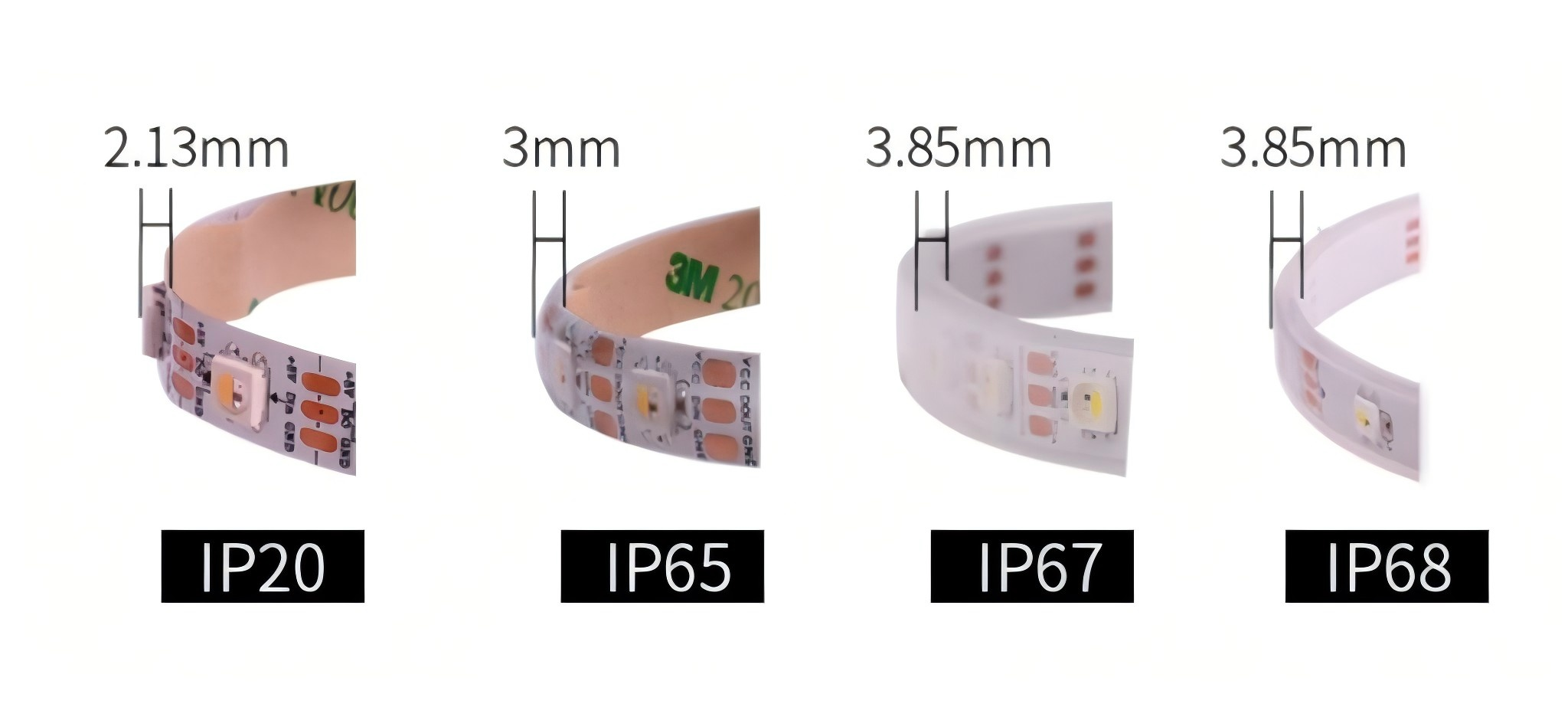
The most common LED strip IP ratings on the market are: IP20, IP65, IP67, and IP68.
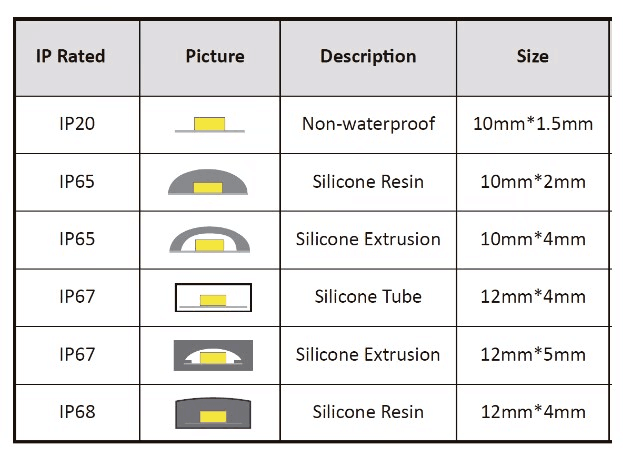
Many customers are often confused when they see these IP ratings, asking:
“The numbers are different—what's the actual difference?”
Instead of diving into the standard definitions, let's explain the differences using real-world usage scenarios for each rating.
IP20 | "For Indoor Dry Areas Only"
You can think of an IP20 LED strip as:👉 Impact-resistant, but not waterproof
No water protection at all
The LED chips and wiring are exposed
Sensitive to water and moisture, but offers the best heat dissipation and highest brightness


📌 Suitable for:
- Living room ceiling light troughs
- Bedroom background lighting
- Inside bookshelves and display cabinets
- Closets and wine racks (away from water)
⚠️ Not recommended for: Kitchen sink areas ,Bathrooms ,Balconies or outdoor spaces
👉 In a nutshell:
Visible and touchable, but keep it away from water.
✅ IP65 | "Daily Waterproof, Most Commonly Used"
This is the most commonly used IP rating in both engineering and home decoration.
- The LED strip is covered with silicone or PU material
- Resistant to moisture and water jets
- Suitable for daily cleaning and humid environments


📌 Suitable for:
- Kitchen work areas
- Bathroom ceilings or handwashing areas
- Balconies and corridors
- Outdoor eaves (but not submerged in water)
⚠️ Caution:
- Can be cut, but the cut edges need to be re-sealed for waterproofing
- Not suitable for prolonged submersion in water
👉 In a nutshell: Moisture and water jets are fine, but don’t submerge it.
✅ IP67 | "Not Afraid of Brief Submersion"
IP67 LED strips are usually fully encapsulated in silicone:
- The LED chips and wiring are completely sealed
- Even temporary water exposure won’t cause immediate damage
- Protection is significantly higher than IP65


📌 Suitable for:
- Outdoor ground edges
- Gardens and courtyards
- Areas prone to water accumulation
- Outdoor environments with frequent rain
⚠️ Caution:
- Not suitable for prolonged underwater use
- Heat dissipation is slightly less efficient than IP20/IP65
👉 In a nutshell:Rain and water accumulation? No problem, but not for "underwater lighting."
IP68 | "True Underwater Use Level"
This is the highest protection rating for LED strips:
- Fully sealed structure
- Can operate continuously underwater
- Requires high standards for sealing, wiring, and craftsmanship
📌 Suitable for:
- Swimming pools
- Water feature decorations
- Fountains
- Internal pool lighting

⚠️ Caution: Highest cost , Not suitable for ordinary indoor or cabinet use (unnecessary)
👉 In a nutshell:Designed for water, but not every project needs it.
What Environments Are Suitable for Different IP Ratings?
|
Usage Environment |
Recommended IP Rating |
|
Living room, bedroom, study |
IP20 |
|
Under cabinets, closets |
IP20/ IP44 |
|
Kitchen work area |
IP44/IP65 |
|
Bathroom |
IP65 |
|
Balcony, corridor |
IP65 |
|
Outdoor eaves |
IP65 /IP67 |
|
Garden, terrace |
IP67 |
|
Swimming pool, water features |
IP68 |
�� Practical Advice: Understand your protection rating—especially in humid areas like bathrooms, the appropriate IP rating is crucial for electrical safety.
If the LED strip might come into contact with moisture or cleaning water, it's better to choose a higher IP rating rather than just meeting the minimum requirement.
Conclusion: Choose the Right IP Rating for Safer and More Durable LED Strips
When selecting LED lighting products for any project, the protection rating (IP rating) is a very important factor to consider.When choosing LED strips, it's not about having the highest IP rating, but the most suitable one.
By understanding the usage environment, humidity conditions, and installation methods, you can achieve the best balance between safety, lifespan, and cost.
If you're unsure which IP rating is best for your project, feel free to:
👉 Contact us for professional selection advice and free samples
👉 Explore our range of LED strip products, covering IP20–IP68 options
Let your lighting not only look great but also stand the test of time and environment.
Common FAQs About LED Strip IP Ratings
Not necessarily. A higher IP rating means stronger sealing, but it can also affect heat dissipation and price. For dry indoor environments, IP20 is often more suitable.
Yes, but after cutting, you need to reapply waterproofing treatment; otherwise, the IP rating will be invalidated.
If it's near the sink or stove, IP65 is recommended; however, for internal lighting in cabinets, IP20 will suffice.
IP67 is suitable for short-term immersion in water, while IP68 can be used underwater for long periods, commonly used in swimming pools or water feature projects.
Surface coatings or encapsulation may slightly reduce light output, but high-quality LED strips can usually control the impact within an acceptable range.